
This was a short legislative session – but this will be a long update.
We won a lot this year. We strengthened our democracy, won protections for workers, and gave our state officials more tools to enforce civil rights and worker rights. We also took a major step toward rewriting our tax code, coming closer to a reality where the wealthiest people in our state pay what they owe our communities.
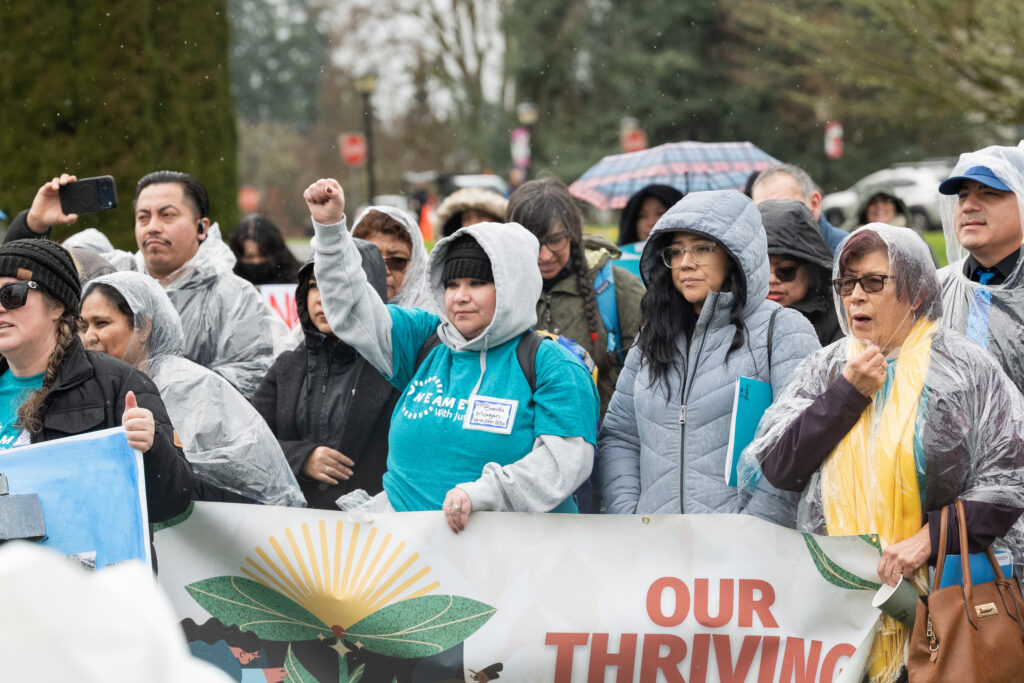
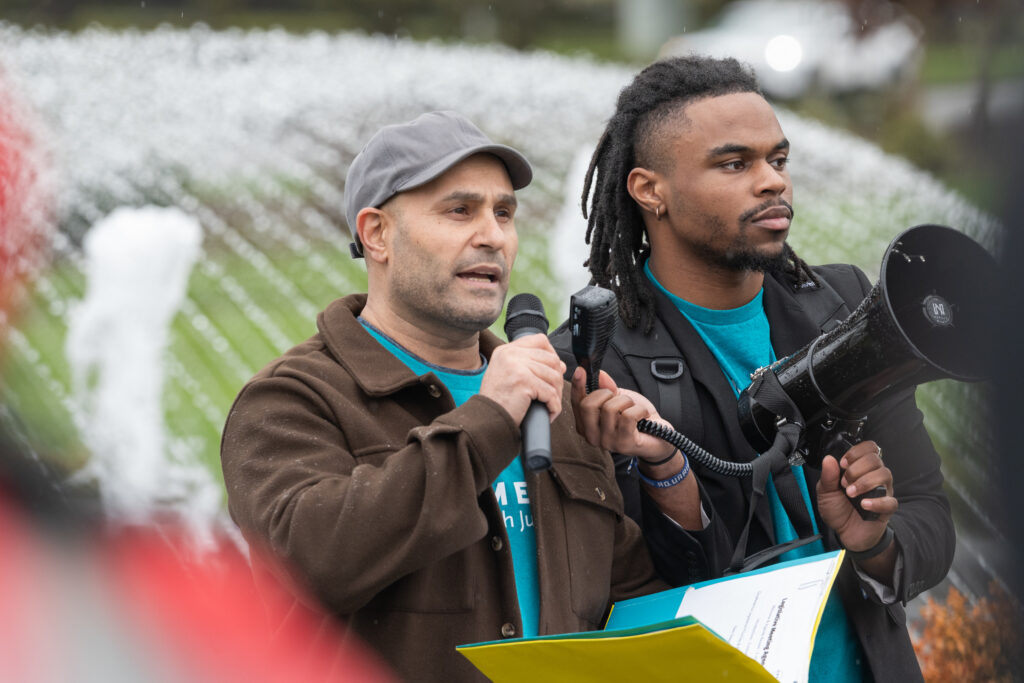
Thank you to our champions in Olympia, to our partner organizations, and to you: the folks who came to our lobby day, who came to our press events, and who contacted their legislators.
Because of you, we protected our people, limited the overreach of the federal government, and made Washington a better state for us all.
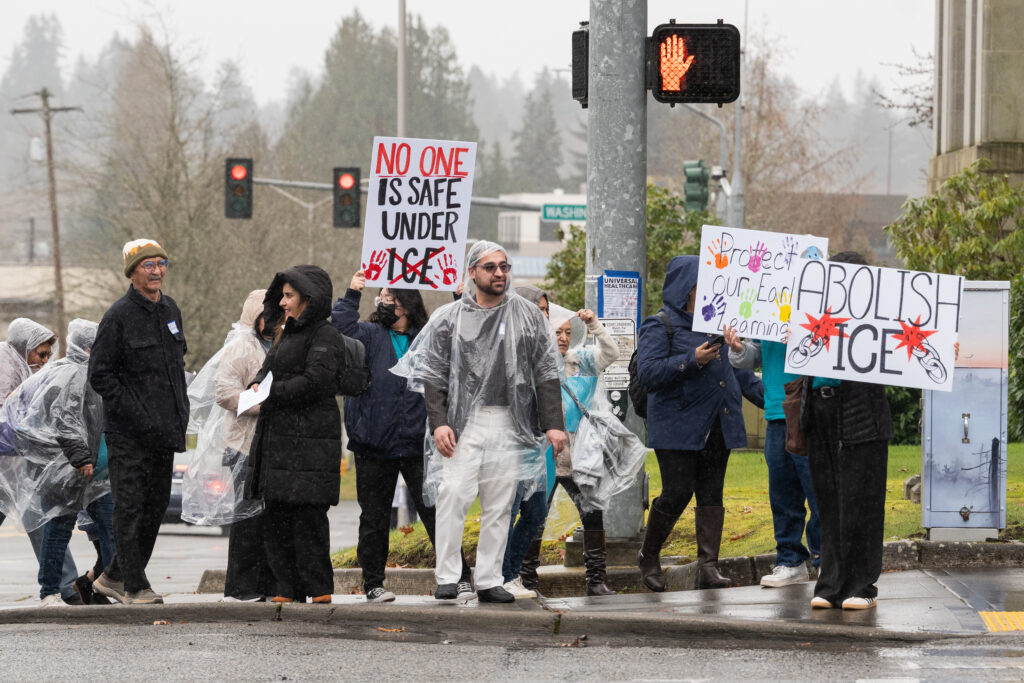
There is a lot more work to do to protect our immigrant neighbors. In a time when immigrants are facing unprecedented attacks, we are continuing to organize.
On April 1, we’re starting a monthly webinar and newsletter where we break down the constant deluge of information on immigrant rights. We’ll dissect federal and state news, analyze what this means for immigrants, and share what you can do to hold the line.
Join us for our first meeting on April 1st at 5pm. RSVP here.
Can’t make it? Make sure you’re on our email list to get these updates in writing.
Protecting Immigrant Workers and Families
No one should have to choose between a paycheck and being deported.
Immigrants are an essential part of our economy, comprising roughly 20% of workers in Washington State. They paid nearly $23 billion in taxes in 2023 alone, with undocumented immigrants contributing $3 billion to that number.
Our state is a stronger place when immigrants both know their rights at work and can use them.
The Immigrant Workers Protections Act (HB 2105) (Prime Sponsors: Sen. Rebecca Saldaña, Rep. Lillian Ortiz-Self) provides guidance to both workers and employers on how to interact with federal immigration agents.
This bill rebalances power between workers and their employers. It puts more responsibility on employers to keep their workers safe. Employers must now provide a written notice to their employees five days in advance of a federal I-9 inspection, which checks employment eligibility and can be a precursor to immigration enforcement. This bill also mandates businesses post information about workers’ rights – and, crucially, it prohibits retaliation against workers who exercise those rights.
Additionally this year, the Domestic Worker Bill of Rights (HB 2355) (Prime Sponsors: Sen. Rebecca Saldaña, Rep. Monica Stonier) passed. This bill, which was championed by Working Washington and domestic workers themselves, advances labor protections for domestic workers.
Now housekeepers, childcare providers, and gardeners will have to be paid at least the minimum wage, are eligible for overtime, and have privacy protections. They can’t be monitored in the bathroom or in their private communications. Their employers also must provide clear contracts in a language the worker understands.
This piece of legislation is a huge deal. Domestic workers have been excluded from basic labor laws in our country for hundreds of years. Today, many of these workers are immigrants, and no longer will they be excluded from basic labor rights in Washington.
Protecting Our Civil Rights
While Washington has a proud history of passing bills to protect immigrants and working people – laws like Keep Washington Working – these laws are only as effective as the state’s ability to enforce them. For many immigrant and low-income workers, justice under these laws is out of reach because they fear losing their job or can’t afford to hire an attorney.
The Attorney General’s Civil Investigation Demands (SB 5925) (prime sponsors: Sen. Drew Hansen, Rep. Dariya Farivar) allows the Attorney General’s office to better enforce workers’ rights and civil rights. It expands the Attorney General’s ability to gather documents and testimonies related to alleged violations of state laws. Now, these tools can be used to make sure that workers aren’t being exploited too.
Sen. Javier Valdez’ bill Restricting the Use of Face Masks by Law Enforcement (SB 5855) also passed this year. This restricts certain face coverings and requires officers to provide identifying information in most circumstances.
Also worth celebrating in HB 2632 (Prime Sponsor Rep. My-Linh Thai), which removes the word “alien” from Washington’s state statutes. Instead, the term “noncitizen” will be used, which restores dignity to immigrants in our state – and brings us in line with Oregon and California’s laws.
Defending Our Democracy
Our voting rights are under attack. Over the last two decades, the Supreme Court has whittled away federal protections for our elections.
We know that our democracy won’t protect itself; only we can save it. And this year, the state legislature passed two bills to strengthen our democracy right here in Washington.
OneAmerica has been fighting to pass preclearance in our state for a decade. And this year, Rep. Sharlett Mena’s preclearance bill (HB 1710) passed!
Under the Federal Voting Rights Act of 1965, places with a history of discriminatory voting practices had to submit any changes in their election laws or districts maps to the federal government before they could take effect. This process of getting approval for changes is known as preclearance.
Preclearance led to an increase both in voting rates among Black and Latino Americans and in the diversity of elected officials. This was the law of the United States until a Supreme Court ruling in 2013, Shelby County v. Holder. Since that ruling, the difference in voting rates between white Americans and Black and Latino Americans has doubled.
HB 1710 makes preclearance the law here in Washington. Jurisdictions with a history of discriminatory voting practices will have to get approval for changes in election policies or maps before enacting them.
This is a big deal. Preclearance will prevent discrimination before it happens and is a powerful tool for immigrants and communities of color to make sure their voices are heard at the ballot box. We’ve been fighting for this for over a decade here in Washington. And now, we join only two other states in the country where this protection is state law: New York and Connecticut.
Preclearance isn’t the only voting rights victory this year.
Guidance on Voter Suppression/Vote Dilution (HB 1750) (Prime sponsor: Rep. Natasha Hill) also passed. This bill establishes a clear definition for voter suppression and vote dilution in Washington State.
According to federal courts, vote dilution can happen in one of two ways. Vote dilution can be caused by using at-large voting districts, where the majority of a population regularly denies a minority the ability to elect candidates of their choice. It can also happen when an electoral district is drawn to either spread minority voters throughout a district (“cracking”) or concentrating their votes in a smaller number of seats (“packing”).
Right now, Section 2 of the Federal Voting Rights Act prevents vote dilution. However, the Supreme Court is hearing a case, Louisiana v. Callais, which could gut the ability of courts to ensure people have the ability to elect candidates from their communities to office.
Together, these bills shift the burden of protecting our vote from individual voters to the government itself.
With our civil rights and democracy under attack by our own federal government, Washington has stood up for our own vision of democracy and fought to secure the civil rights of all Washingtonians within our own state.
Fixing our Tax Code
The big news this year in Olympia was the passage of the Millionaires’ Tax.
This bill applies a 9.9% tax on household earnings over $1 million, starting in 2029. This means that if you earn $1,000,010, you’ll only be taxed on the $10 and pay $0.99.
The money from this tax will go toward expanding the Working Families Tax Credit, supporting childcare and early learning, and providing free school lunch to K-12 students. It also eliminates sales taxes on products including diapers and toothpaste and cuts taxes for small businesses.
While this bill won’t take effect until 2029, it is a big win for immigrants and working people in our state.
Winning a Budget for on Immigrant Justice
Our state is still in a budget hole, but we managed to fight off the worst of the cuts facing programs our communities depend on.
Our Washington New Americans citizenship program will be fully funded for another year, as will the Washington Migrant and Asylum Seeker Support (WAMASS) program, which provides assistance to asylum seekers and some of the most vulnerable immigrants in our state.
We also fought hard to mitigate cuts to key education programs.
- Dual language program funding in K-12 schools will be cut by $250,000, which is half as much as initially proposed in the Senate.
- Working Connections Childcare will see rate changes.
- No changes are going to be made to either equity grants, the dual language enhanced rate, or other auxiliaries paid to childcare providers.
While we are disappointed in these cuts, we also know that without the advocacy of childcare providers, union members, and organizations across the state, they could have been a lot more dire.
What’s next?
Of course, many good bills led by our coalition partners and champions in the legislature did not pass this year. We’ll be back in Olympia fighting for them again next year.
A bill strengthening reporting requirements and law enforcement responses at private detention facilities (HB 2465) led by Rep. Lillian Ortiz-Self did not make it out of the house this year. At a time when the federal government is detaining and deporting more and more of our neighbors, this bill would have given the state more control over facilities like the Northwest Detention Center in Tacoma – and protected more immigrants being held there from abuse and injury.
A protected areas bill, sponsored by Senator Drew Hansen (SB 5906) also did not pass this session. This bill would have established health care facilities, schools, colleges, and other locations as spaces protected from immigration enforcement, restoring a policy that had existed for decades before being abandoned by Donald Trump.
And a bill which would have given farmworkers collective bargaining rights here in Washington (SB 6045) also failed to advance this year. Championed by organizations like Community to Community, this bill would have extended the same rights to form a union to farmworkers as other workers, fixing a historic injustice at a time when many farmworkers are under attack.
Then there is the bill regulating Automated License Plate Readers (ALPRs).
The Driver Privacy Act (SB 6002) (Prime Sponsors: Sen. Yasmin Trudeau, Rep. Osman Salahuddin) did pass this year. It is a step toward establishing guardrails on surveillance technology.
This is the first time ALPRs have been regulated in Washington – and the regulations do not go far enough. Agencies can still hold on to data about where you drive for too long, which puts immigrants and many others in our state at risk.
A lot more work needs to be done to regulate surveillance technology before we can celebrate this as win. Stay tuned.
That’s a wrap on legislative session 2026. We hope you can join us on April 1st and we will be back in Olympia the second Monday in January of 2027.